


The FY26 National Defense Authorization Act (NDAA), spanning more than 3,000 pages, was signed into law last week. While the NDAA does not provide actual budget authority–which will come through a dedicated appropriations bill–it sets key defense policy and spending caps for programs and activities. It is the blueprint Congress lays each year for the Department of War to modernize the force, accelerate and acquire emerging technologies, and expand industrial capacity.
The Research, Development, Test & Evaluation (RDT&E) budget was the biggest winner in the NDAA, receiving +$35B more than the FY25 enacted RDT&E budget.* By raising spending caps for the development of next-generation technologies, Congress is laying the groundwork for resourcing the Pentagon’s modernization and rapid prototyping efforts in the new year. The below analysis will dive into the FY26 NDAA’s RDT&E numbers, highlight the biggest movers at the program-level, and signal what the shifts mean for defense priorities moving forward.
RDT&E: The NDAA’s Biggest Winner
- Congress authorized a total defense discretionary budget of $900.6B, +$8.0B (+.8%) more than the FY26 Presidential Budget Request (PB)**.
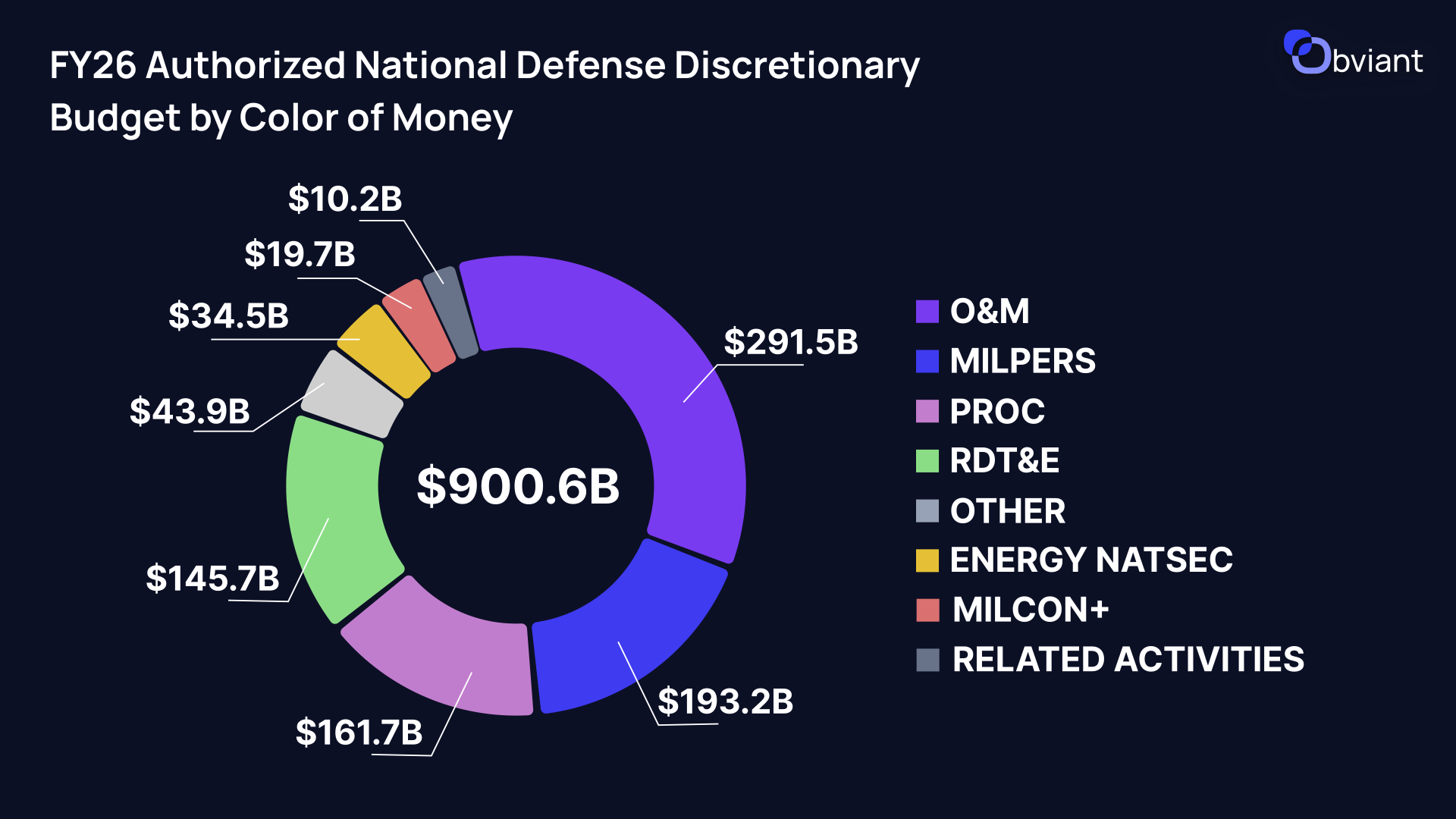
- $7.5B of the $8.0B difference mostly consists of increases in RDT&E (+$3.7B), Procurement (+$8.9B), and Military Construction (MILCON) (+$844M) dollars offset by a drop in the Operations & Maintenance (O&M) (-$4.1B) and Military Personnel (MILPERS) (-$1.5B) budgets.
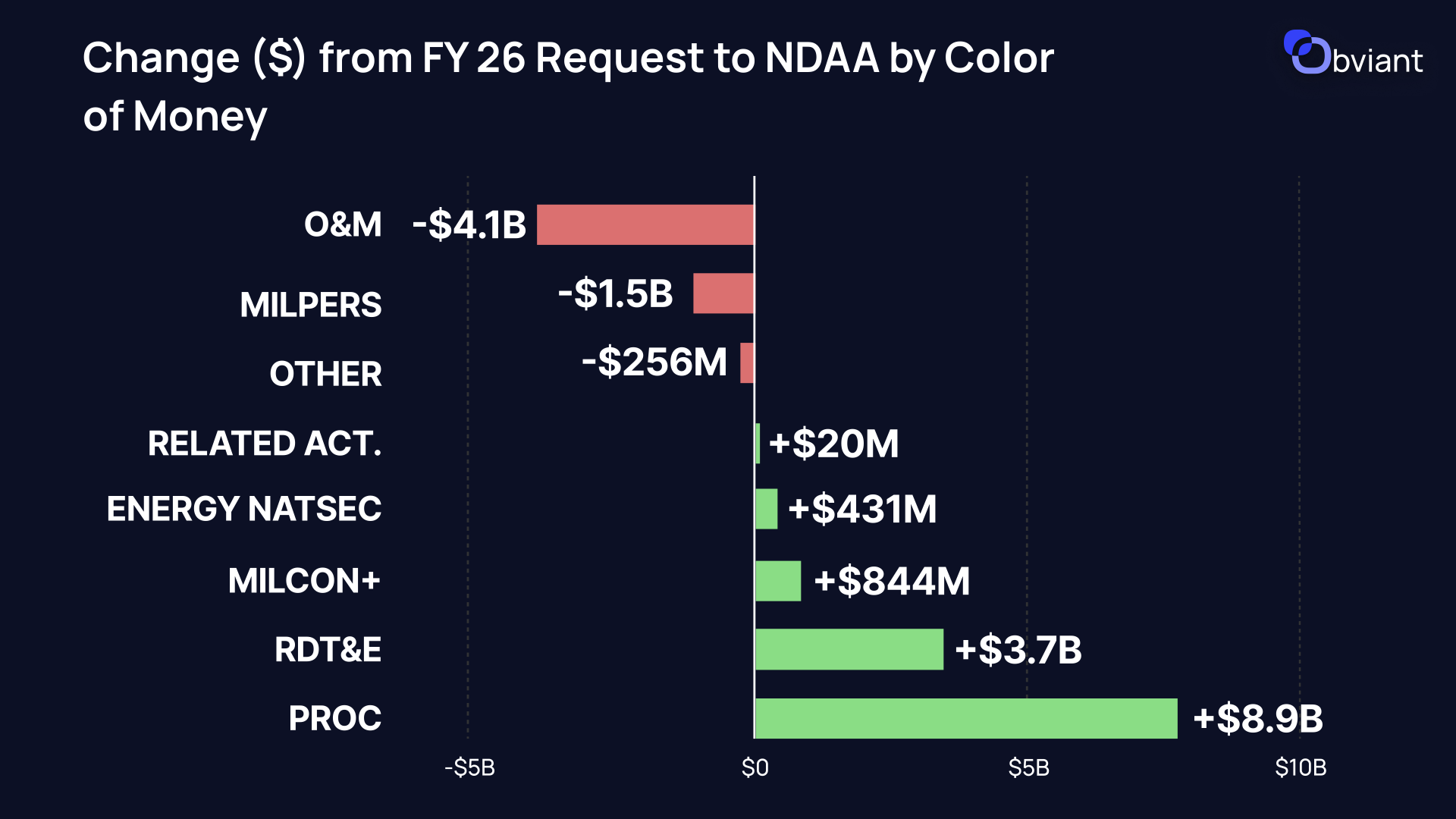
- While Procurement and MILCON also gained in the FY26 NDAA, RDT&E is the biggest winner.
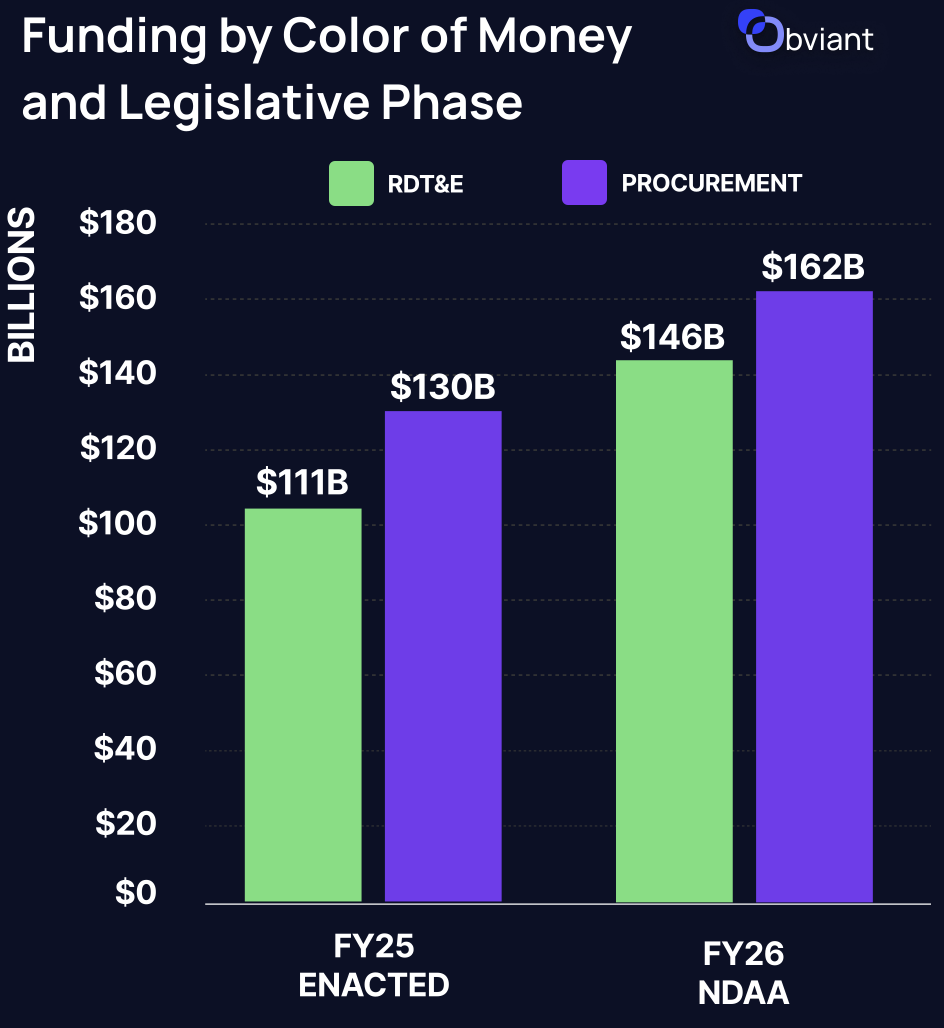
- Procurement saw the largest authorization increase compared to the FY26 PB, but RDT&E saw a larger year-over-year (YoY) increase (+$35B, +31.5%) from FY25’s enacted budget of $111B, with Procurement receiving a +$32B boost (+24.6%) from $130B.
New Emphasis on Late-Stage Development and Fielding
The RDT&E topline does not tell the whole story, however. Shifts within research budget activity (BA) classifications highlight an appreciable movement away from early stage activities and prototyping and towards demonstration, testing, and fielding of capabilities.
The BA classification system shows how far along RDT&E program elements are in the development process. On a scale, lower BAs denote basic research, while higher BAs represent more operational stages ready for testing and deployment.

- Budget activity 1-4 authorizations, representing early stage RDT&E, see a net decrease of -$2.6B (-4.9%) from FY25 while budget activities 5-9 grow by a combined +$6.4B (+12.4%).
The growth of RDT&E in the FY26 NDAA is not just a story of increasing investment in the next-generation of technologies, but also one of growing emphasis on moving systems out of prototyping and into the field for testing and iterative development. Money flowing out of BA 4 and into BAs 5, 7, and 9 will necessarily privilege systems that require less time and resources to prototype–such as commercial-off-the-shelf solutions–and will get them into the field for testing sooner.
Program-Level RDT&E Shifts
Changes in program-level budgets indicate how Congress and the Pentagon’s priorities for certain systems and capabilities have shifted since last year. A number of programs received a significant boost from their FY25 funding levels while others were trimmed or eliminated.
Accelerating
➚ Select Golden Dome Efforts Boosted:
- Ground Moving Target Indicator (GMTI):
- The Space Force—working with the Intelligence Community (IC)—is accelerating the GMTI space-based radar capability to detect and track moving ground and maritime targets and feed joint kill chains.
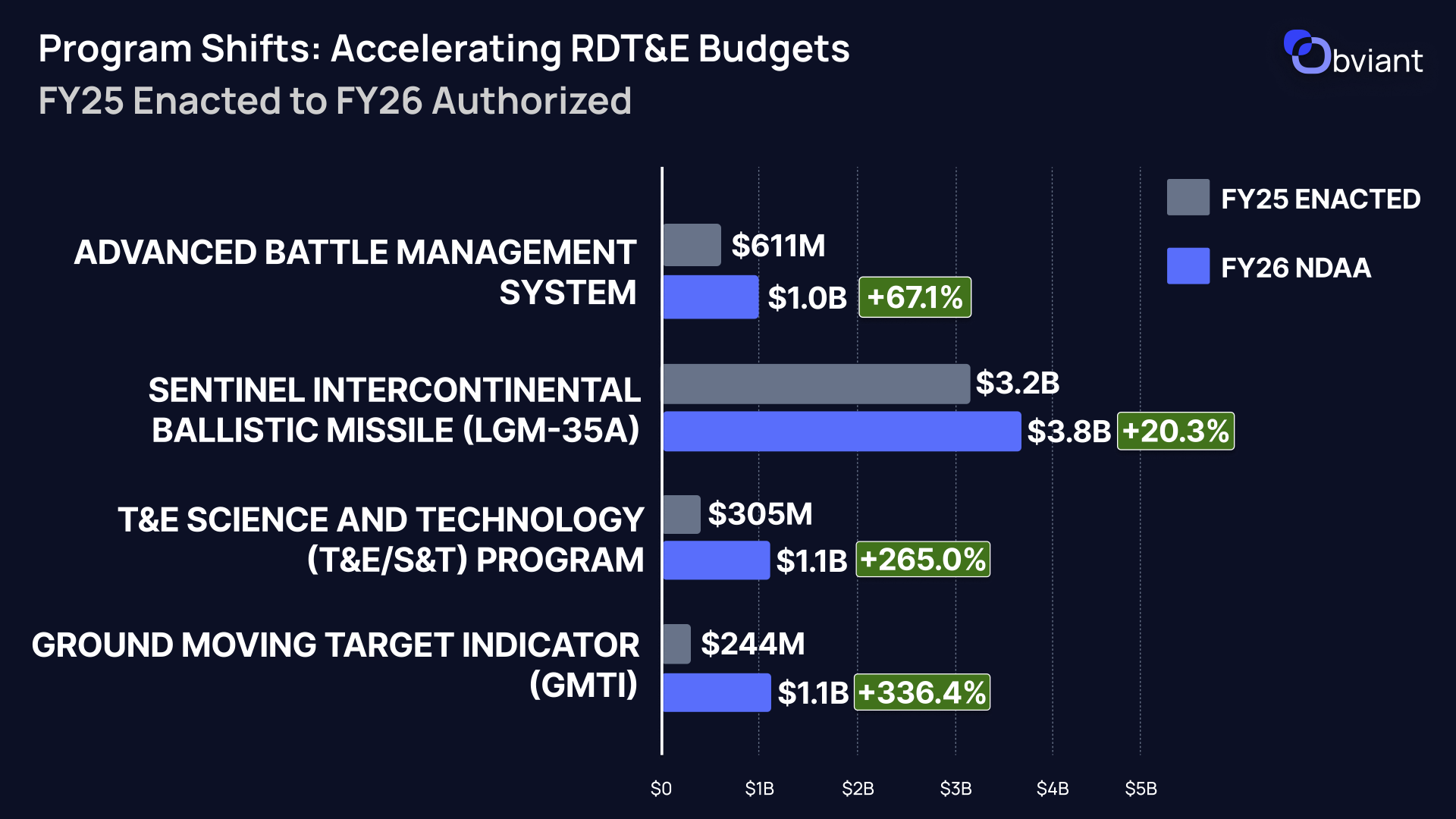
- Congress has more than quadrupled the authorized RDT&E budget for GMTI to $1.1B (+$821M, +336.4%) due to “ramp up of production” and a move from BA 5 to BA 7 according to budget documents.
- Dedicated GMTI satellites are expected to begin launching in 2028, with initial operational focus tied to INDOPACOM, signaling sustained momentum for the emerging space radar architecture.
- While most contracts for GMTI are classified given the partnership with the IC, BlackSky Geospatial Solutions was awarded a $1.5M SBIR phase II for GMTI in 2022 through 2026.
- Sentinel ICBM Development:
- Congress continues the development of the LGM-35A ICBM–the country’s next-generation ground-based strategic deterrent–boosting the program’s budget +$650M (+20.3%) YoY. The system is now being envisioned as a Golden Dome project.
- The gradual replacement of the Minuteman III with the LGM-35A has faced significant cost overruns. Obviant data shows that the active $10.8B contract Northtrop Grumman has to develop the missile through 2029, the company’s largest by current obligation with the government, has $27.0B in total subcontracts thus far.
- Congressional authorizers included a +$1.2B program increase specifically to restore full funding for the next phase of its development, expressing continued support in lieu of viable alternatives, according to the conference committee’s Joint Explanatory Statement.
➚ Test & Evaluation (T&E) for Hypersonics:
- The authorized RDT&E budget for the T&E Science & Technology (T&E/S&T) Program was more than triple its FY25 enacted budget at $1.1B (+265.0%).
- The DoW is looking to accelerate the pace of hypersonic missile testing through the Multi-Service Advanced Capability Hypersonics Test Bed (MACH-TB 2.0) to 50 tests per year.
- Test infrastructure and programming like MACH-TB 2.0 are critical enablers given the NDAA’s emphasis on testing and late-stage development and test infrastructure.
- Kratos Defense & Security Solutions leads the MACH-TB 2.0 initiative along with a team of partners, and stands to benefit from continued investment in the test bed.
➚ AI and Human-Machine Teaming for Air Force C2:
- Congress has more than doubled (+$448.7M) the Advanced Battle Management System (ABMS) program’s RDT&E budget to connect Air Force and Space Force sensors, systems, and weapons through a shared digital infrastructure.
- ABMS development efforts currently include experiments in human-machine teaming to accelerate C2 decision-making, a key test case for the Department’s integration of AI capabilities for the future force.
- Leidos holds a $21.3M ($304.7M ceiling) contract to build out the digital infrastructure for ABMS through 2027 with options to extend to 2029.
Decelerating
➘ Proliferated Warfare Space Architecture (PWSA):
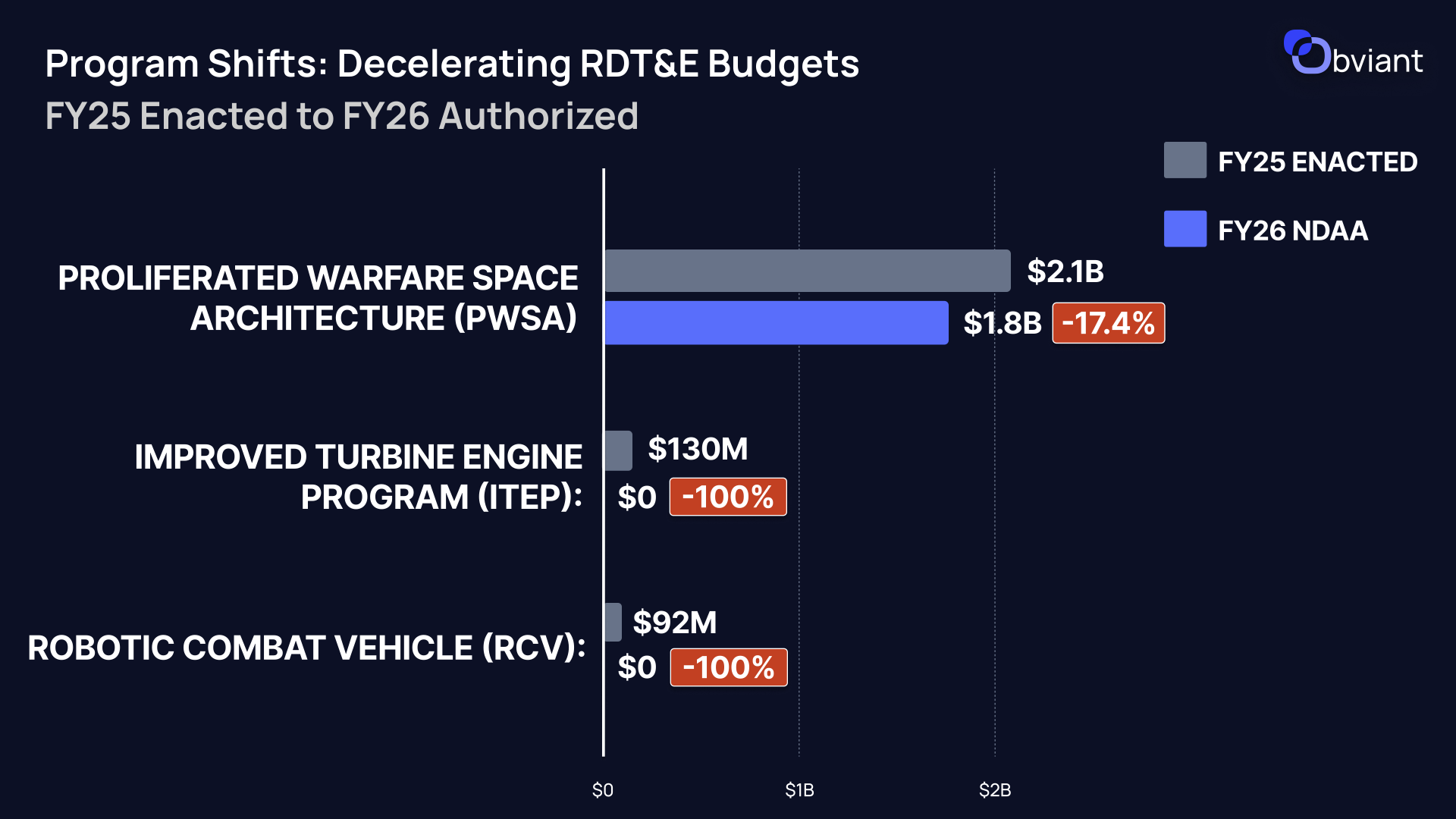
- Congress matched the PB’s $1.3B request for the PWSA, a next-generation space-based missile and tracking architecture. However, despite the program’s clear connection with Golden Dome priorities, its NDAA-authorized budget was decreased -$372.6M from its FY25 enacted level due to “adjustments for other USSF priorities,” the single-largest YoY RDT&E reduction in the NDAA.
- Several defense contractors have large active contracts for PWSA through 2029, including Northrop Grumman ($1.1B), General Dynamics ($733.7M), L3 Harris ($539.4M), and Lockheed Martin ($521.7M).
➘ Army Transformation Initiative (ATI) Cuts Codified:
Certain cuts within the NDAA codify program cancellations from the Army’s Transformation Initiative (ATI) to eliminate obsolete or lower-priority programs.
- Improved Turbine Engine Program (ITEP):
- Congress followed through with the Pentagon’s cancellation of the ITEP program, which was intended to provide an improved common engine for the Army’s helicopter fleet.
- The engine’s first successful flight test was conducted in May 2025, but the authorized budget was zeroed-out (-$130M) in the NDAA with no follow-on funding for procurement, signaling the new engine will not developed further or fielded.
- General Electric has $834.4M in active contracts to develop the engine through 2029 while Sikorsky ($152.2M) and Boeing ($50.5M) each have separate contracts to integrate the engine into their respective Black Hawk and Apache helicopters.
- Robotic Combat Vehicle (RCV):
- The RCV program was also cut (-$92.5M) in line with the ATI.
- Textron Systems had reportedly won the RCV competition for its Ripsaw 3 vehicle, though no contracts had been awarded.
- Pentagon officials stated that the Department would seek out a consortium of vendors for future unmanned vehicles rather than rely on a single supplier.
The FY26 NDAA’s RDT&E signal is about tempo and follow-through. Congress is authorizing more investment overall while shifting the center of gravity away from early exploration and toward demonstration, test, integration, and fielding. That mix suggests a desire to turn modernization into near-term capabilities, with funding and authorities aligned to move programs through the pipeline faster and reduce the time spent in perpetual prototyping.
What to Watch
FY26 Appropriations:
- While the NDAA gives an important indicator of what the House and Senate Armed Services Committees view as top priorities for RDT&E, appropriators must follow-through with funding at or near the NDAA’s toplines for those changes to become reality.
- In Congress, jurisdiction over spending bills sits with the appropriations committees, separate from the Armed Services committees that draft the NDAA each year.
- For defense spending, the House and Senate Appropriations Subcommittees on Defense (HAC-D and SAC-D) write the initial funding bills, but final funding levels are determined only after full committee action, passage by both chambers, and enactment.
- In July 2025, the House passed its FY2026 Department of Defense appropriations bill (H.R. 4016), while the Senate Appropriations Committee reported its version (S. 2572) on July 31, 2025, though a Senate floor vote has not happened as of this writing. The House and Senate bills differ from each other and can differ from the NDAA.
- It remains to be seen whether Congress will enact a full-year FY26 defense appropriations bill before the current continuing resolution expires on January 30, 2026. If not, the Pentagon will likely operate under another CR, unless an appropriations lapse causes a government shutdown.
Success Rate of NDAA’s Biggest Winners:
- If appropriations follow-through and defense acquisition reforms bear fruit, look for stated development, prototyping, and procurement timelines to meet or beat stated goals. There are several notable baselines to measure the success of well-resourced programs.
- GMTI slated for launch by 2028.
- Sentinel ICBM to replace Minuteman by the end of the decade.
- MACH-TB 2.0 to reach 50 tests/year.
*Authorizations "received" through the FY26 NDAA are subject to appropriations through a dedicated funding bill which has yet to be passed as of this writing.
**All numbers drawn from the FY26 Presidential Budget Request are not inclusive of Reconciliation funding enacted through the One Big Beautiful Bill Act (OBBBA).
Acronyms
O&M - Operations & Maintenance
MILPERS - Military Personnel
PROC - Procurement
RDT&E - Research, Development, Test, and Evaluation
MILCON+ - Military Construction, Family Housing, and Base Realignment and Closure
ENERGY NATSEC - Department of Energy national security programs
